
About the institution and the team
Wuxi Taihu University is a full-time, multidisciplinary, application-oriented undergraduate institution approved by China’s Ministry of Education. Founded in 2002, it was approved in 2017 as an institution preparing to grant master’s degrees.
The Institute of Mechanics in the School of Intelligent Equipment Engineering is based in Wuxi and serves the wider Yangtze River Delta. Its applied research focuses on lightweight design, safety and reliability assessment, and intelligent optimization for advanced equipment. Its capabilities include structural mechanics modelling, finite-element simulation, strength verification, topology and lattice optimization, and physics-informed intelligent prediction.
Led by Dr Songhua Huang, Associate Professor, this technology capability serves aerospace, high-speed rail, automotive components, and advanced manufacturing. It can support an engineering project from problem definition and computational analysis through to design verification.
Solution overview
Advanced structural design often faces an inherent conflict: a component must be lighter, stronger, and faster to develop at the same time. Conventional design commonly assumes a single elastic load case. Under variable or repeated loads, or in coupled thermal and mechanical environments, it can require many expensive simulation iterations. Purely data-driven models, meanwhile, often lack physical interpretability and are difficult to use directly in engineering decisions.
The proposed solution combines physics-informed neural networks, structural topology optimization, and coupled thermal–mechanical–fluid modelling. It targets lightweight design and in-service performance prediction for aerospace vehicles, high-speed trains, and other advanced transport equipment. Physics-constrained surrogate models enable rapid analysis and optimization in complex coupled environments and provide dependable computational support for digital twins and structural safety assessment.
Case 01 · Lightweight topology–lattice co-design
For lightweight spacecraft, advanced equipment, and additively manufactured components, the team incorporates shakedown strength, stiffness, modal behaviour, and energy absorption into a unified design process. Topology optimization first identifies the principal load paths. Variable-density lattices are then introduced according to local loading demands, and finite-element simulation together with test data is used to verify structural performance.
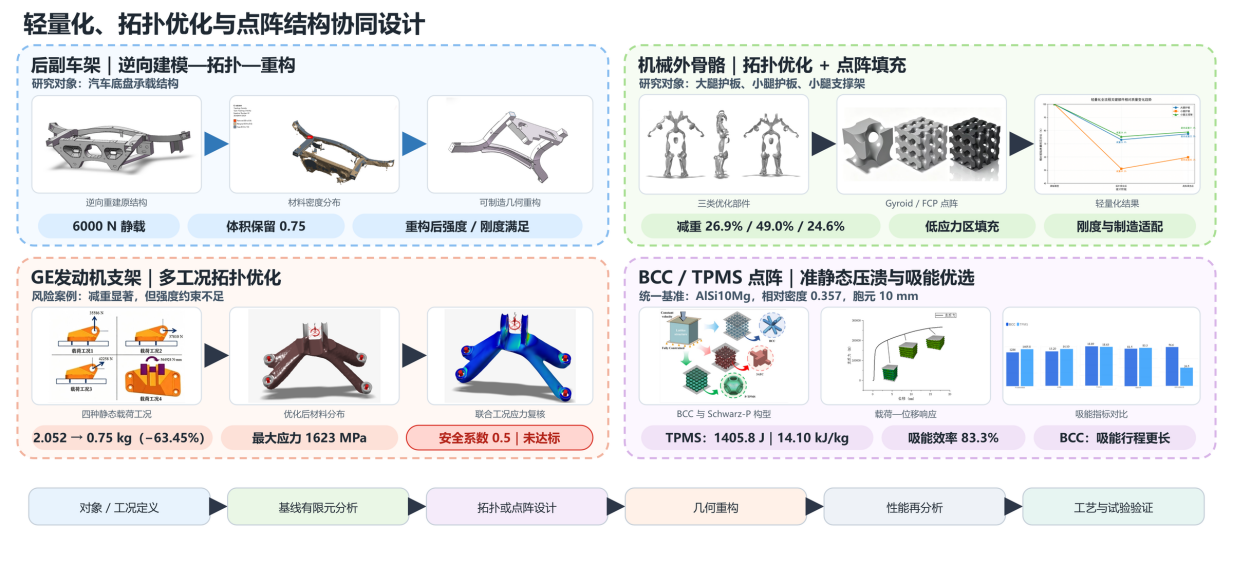
- Weight and load-bearing performance are optimized together, avoiding material removal that compromises stiffness, strength, or shakedown capacity.
- Macro-scale topology and micro-scale lattice design are coordinated to balance lightweighting, energy absorption, vibration behaviour, and manufacturability.
- The workflow can be reused for satellite boxes, mechanical exoskeletons, brackets, energy absorbers, and other complex load-bearing structures.
Case 02 · Physics-informed neural networks for faster strength assessment
Displacement, stress, equilibrium equations, yield conditions, and residual-stress constraints are embedded in a physics-informed neural network so that elastic fields and self-equilibrated residual-stress fields can be learned together. The resulting model addresses expensive simulations, limited experimental data, and the need for rapid multi-load-case assessment. It can act as an efficient surrogate in structural optimization, design-space exploration, concept screening, inverse identification, and digital-twin updates.
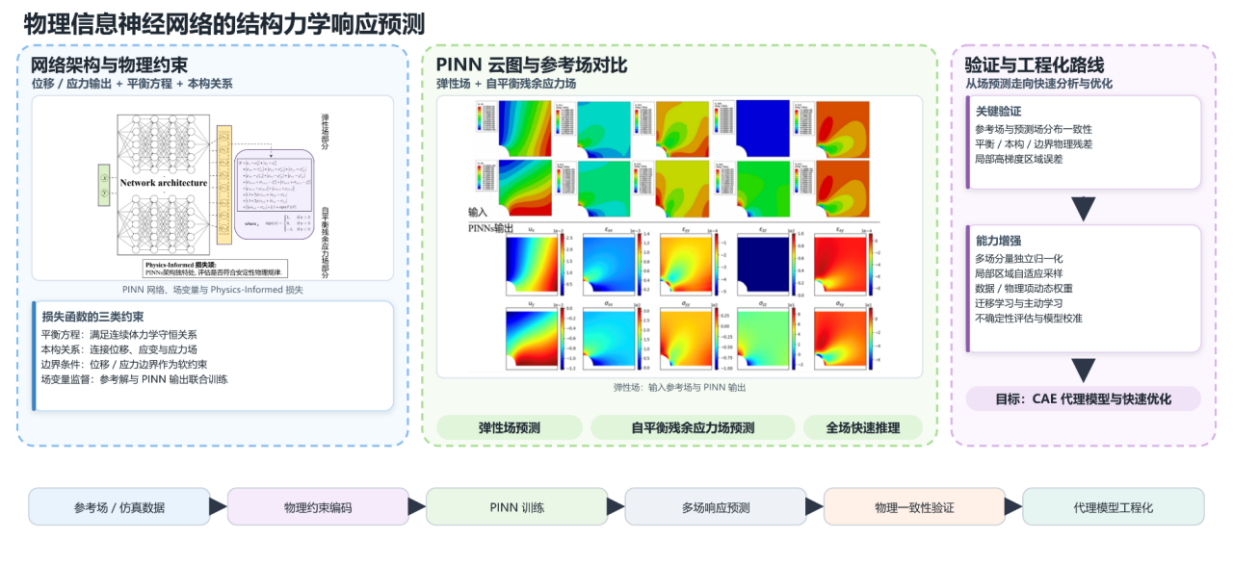
- Physical laws and boundary conditions are written directly into the loss function, reducing dependence on large labelled datasets.
- The model connects with parametric finite-element models for multi-concept screening, inverse identification, and rapid digital-twin updating.
Case 03 · Multiphysics modelling and optimization of advanced transport equipment
For aerospace and high-speed-rail structures, the team combines coupled thermal–mechanical–fluid modelling, topology optimization, and physics-informed neural networks. The approach supports rapid analysis, optimization, and performance prediction for complex structures exposed to temperature gradients, fluid loads, vibration, and large deformation.
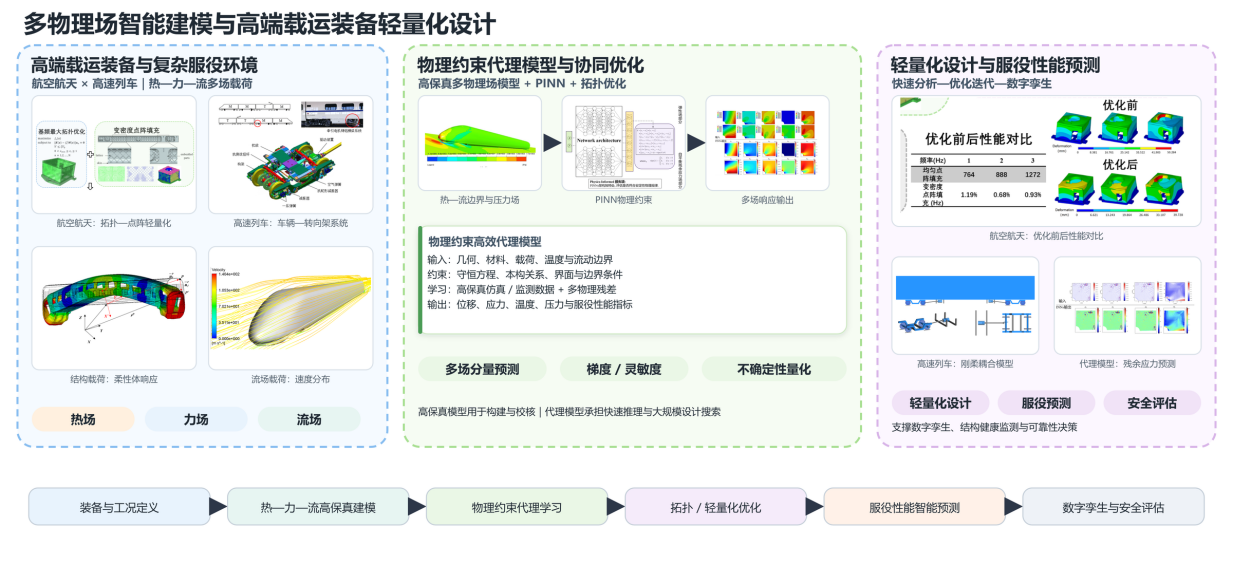
- Coupled models connect temperature fields, flow fields, pressure loads, structural response, and flexible-body dynamics.
- Efficient surrogate prediction reduces repeated computation and supports parameter identification and online updates for digital twins.
Ways to collaborate
- Joint R&D on multi-load-case modelling, lightweight design, and strength prediction for aerospace, rail transport, and advanced equipment.
- Technical services based on an organization’s structural models, material parameters, and load spectra, including performance assessment, topology or parametric optimization, secondary algorithm development, and technical reporting.
- Scenario validation in which an industry partner provides real structures, load cases, data, or test conditions while the research team supplies models, algorithms, and iterative optimization.
- Joint applications for research projects and co-development of papers, patents, software copyrights, or engineering prototypes.